
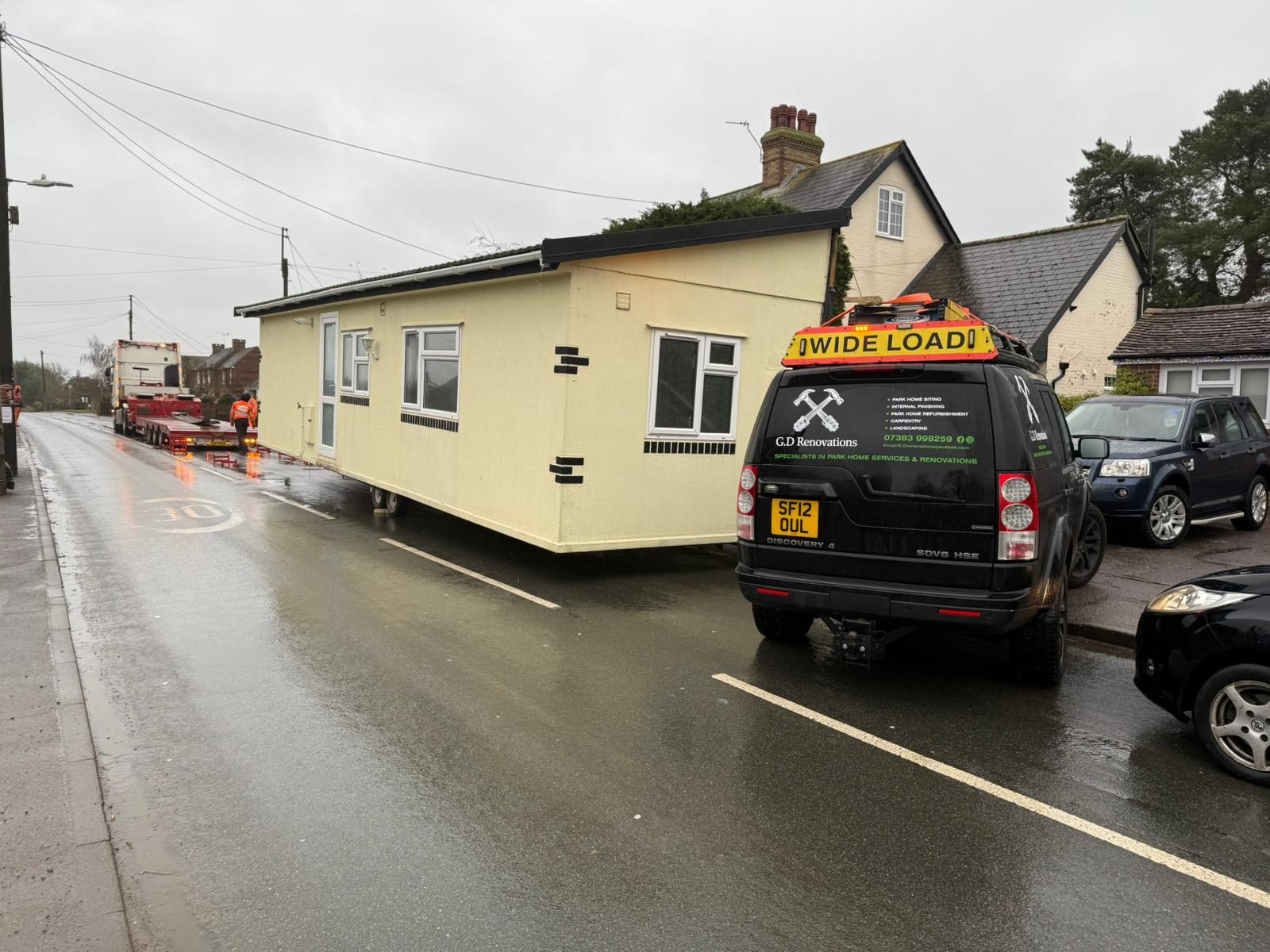
If you’re planning to move a static caravan and wondering whether an escort vehicle is legally required, the answer depends almost entirely on the width of your unit. Most static caravans measure between 10 and 12 feet wide – that’s roughly 3.0 to 3.7 metres – which already puts them into abnormal load territory. At those widths, an escort vehicle is not just a nice idea; for many moves it is a legal requirement, and for the widest homes it is a matter of police involvement and special consent.
Why static caravans are abnormal loads
Any vehicle or load exceeding 2.9 metres in width on a UK road is legally classified as an abnormal load. Because static caravans are typically 10–12 ft (around 3.0–3.7 m) wide, the vast majority immediately cross that threshold. That classification triggers a legal framework of notifications, permits and – at certain widths – mandatory escorting.
Unlike a touring caravan, a static cannot be towed behind an ordinary vehicle. It travels on a specialist low-loader or step-frame trailer at slow speeds, with a route carefully planned in advance to avoid low bridges, weight-restricted roads and tight bends. Escort vehicles are part of that safety picture.
The width thresholds that trigger escort rules
UK abnormal load law sets out a clear progression based on the overall width of the load. Here is how it works in practice:
| Overall width of load | What is required |
|---|---|
| Up to 2.9 m | No abnormal load classification – standard road use |
| Over 2.9 m up to 3.5 m | ESDAL notification to police and highways authorities; two clear working days’ notice; marker boards required |
| Over 3.5 m | ESDAL notification plus a mandatory attendant/escort – an additional person (or escort vehicle) is legally required to warn other road users of danger |
| Over 5.0 m | National Highways VR1 consent required; individual police forces typically require a police escort for the movement |
Because most residential park homes and larger holiday statics sit in the 3.5–4.5 m range, an escort vehicle is required for a significant proportion of moves – not the exception. Twin-unit homes, which are moved as two separate halves, can be even wider.
What does an escort vehicle actually do?
It’s worth being clear about what a private escort can and cannot do under UK law. A private escort vehicle – typically a van or 4×4 fitted with amber beacons and “ABNORMAL LOAD” signage – has no powers to stop or direct traffic. Its legal purpose is to warn other road users of the approaching wide load and to support the driver in navigating hazards.
In practice, an escort driver will:
- Typically travel ahead of the low-loader (front escort) or behind it (rear escort), depending on the route and load
- Communicate with the driver by radio when negotiating junctions, tight bends or oncoming traffic
- Alert motorists who are approaching the wide load
- Liaise with the police or highway authority if an incident arises on the route
For loads over 3.5 m wide, having at least one additional person fulfilling this escort role is a legal requirement – whether that person travels in the cab or in a separate escort vehicle. For wider loads on more complex routes, two escort vehicles (one front, one rear) may be deployed.
When is a police escort needed?
Police forces in England, Scotland and Wales no longer routinely escort abnormal loads as a matter of course. For most static caravan moves – including those that require a private escort – the police are notified via the ESDAL system at least two clear working days before the move, but they do not attend in person.
A police escort becomes more likely in these circumstances:
- The load exceeds 5.0 m in width (many forces require police escorting at this size as a matter of policy)
- The route passes through a particularly congested town or city centre
- The haulier specifically requests police attendance, for example on an unusually complex route
- A local force exercises its discretion based on the specific circumstances
For moves over 5.0 m wide, National Highways VR1 consent must also be obtained before the vehicle travels on any trunk road or motorway. This is separate from the ESDAL notification and can add lead time to the planning process.
How Static Caravan Movers handles this for you
At Static Caravan Movers, every job starts with a route survey and load assessment. We confirm your unit’s exact dimensions, file the ESDAL notification to police and highway authorities across the full route, and arrange any required escort vehicles. Where the load size demands it, we brief front and rear escorts on the specific hazards for that journey.
Transport pricing starts from £950 for most moves. Required escorts, ESDAL notifications and standard permit fees are built into the quote – no hidden compliance add-ons. If your move is likely to need National Highways VR1 consent or a police escort, we flag that clearly before you commit.
What about access to your site – can the lorry get in?
A low-loader carrying a 3.5–4.0 m wide static caravan is a long, slow vehicle that needs a clear approach to the pitch – and an escort vehicle extends the overall convoy length. Before confirming a booking, think about:
- The width and overhead clearance of the park entrance and internal road
- Whether there are sharp bends or low barriers between the gate and the pitch
- Whether the destination pitch has been prepared and has enough working space around it for jacking and positioning
- Whether your park management has been informed and has given access approval
If you have any doubt about access, share photos or dimensions with us when you enquire. We can often spot potential issues early – which saves everyone time on move day.
A note on twin-unit homes
If you are moving a twin-unit static caravan or park home, both halves travel as separate abnormal loads on separate low-loaders. Each half still needs to comply with the width rules above, but the reassembly and resealing work on site is more involved. De-siting and re-siting for twin-unit and larger specialist homes typically costs £4,000–£5,000 to reflect the additional labour and time required.
Frequently asked questions
Does every static caravan move need an escort vehicle?
Not every move, but the majority. Any load over 3.5 m wide legally requires an attendant or escort. Most standard static caravans are 10–12 ft (3.0–3.7 m) wide, so roughly the upper half of the typical size range – and virtually all residential park homes – require an escort. Units under 3.5 m wide still require ESDAL notification and marker boards, but a separate escort vehicle is not a legal requirement in that case.
How far in advance does the move need to be booked?
ESDAL requires at least two clear working days’ notice to police, so last-minute bookings are not possible for most static caravan moves. We typically ask for at least a week’s lead time for route planning, ESDAL submission and escort co-ordination. Moves over 5.0 m wide requiring National Highways VR1 consent need more lead time still.
Who pays for the escort vehicle – is it included in the quote?
Yes. At Static Caravan Movers, the cost of required escort vehicles, ESDAL notifications and standard permit fees is included in the price we quote. We do not add these as separate line items after you have agreed to proceed. Transport starts from £950, and anything above that driven by the size of your unit or the complexity of the route will be explained upfront.
Do you need a police escort as well as a private escort?
For the majority of moves, no. Police forces across the UK no longer routinely attend abnormal load movements. The ESDAL notification satisfies the legal requirement to inform them. A police escort becomes relevant for loads over 5.0 m wide (many forces require it at that size), for particularly complex urban routes, or if the haulier requests police attendance for a specific reason. If your move falls into a category where police escorting is likely, we will tell you at quotation stage.
What if my caravan is just under 3.5 m wide – do I still need to notify anyone?
Yes. Any load over 2.9 m wide is an abnormal load and requires ESDAL notification to police and relevant highway and bridge authorities at least two clear working days before the move. Even if an escort vehicle is not legally mandated at widths between 2.9 m and 3.5 m, the notification requirement and the need for marker boards still apply. We handle all of this as part of the standard service.
What are marker boards and do all moves need them?
Marker boards are yellow-and-black striped boards displayed at the front and rear of the load to make its width visible to other drivers. They are a legal requirement for any abnormal load on UK roads. Your transport company should fit them as a matter of course – it is not something the owner needs to arrange.
Can I arrange the escort vehicle myself to save money?
In principle, the escort vehicle and the low-loader can be provided by different companies. In practice it creates unnecessary risk: the escort driver needs to be briefed on the route, load dimensions, ESDAL details and the plan for difficult sections. We include escort co-ordination as part of the job precisely because it needs to be joined up.
Does the same escort requirement apply if I’m moving a park home rather than a holiday static?
Yes – the road law does not distinguish between a holiday static and a residential park home or mobile home. The escort rules apply based on the physical dimensions of the load. Residential park homes are often wider and longer than holiday statics, so they are more likely to require an escort and more likely to need National Highways consent if they approach or exceed 5.0 m in width.