
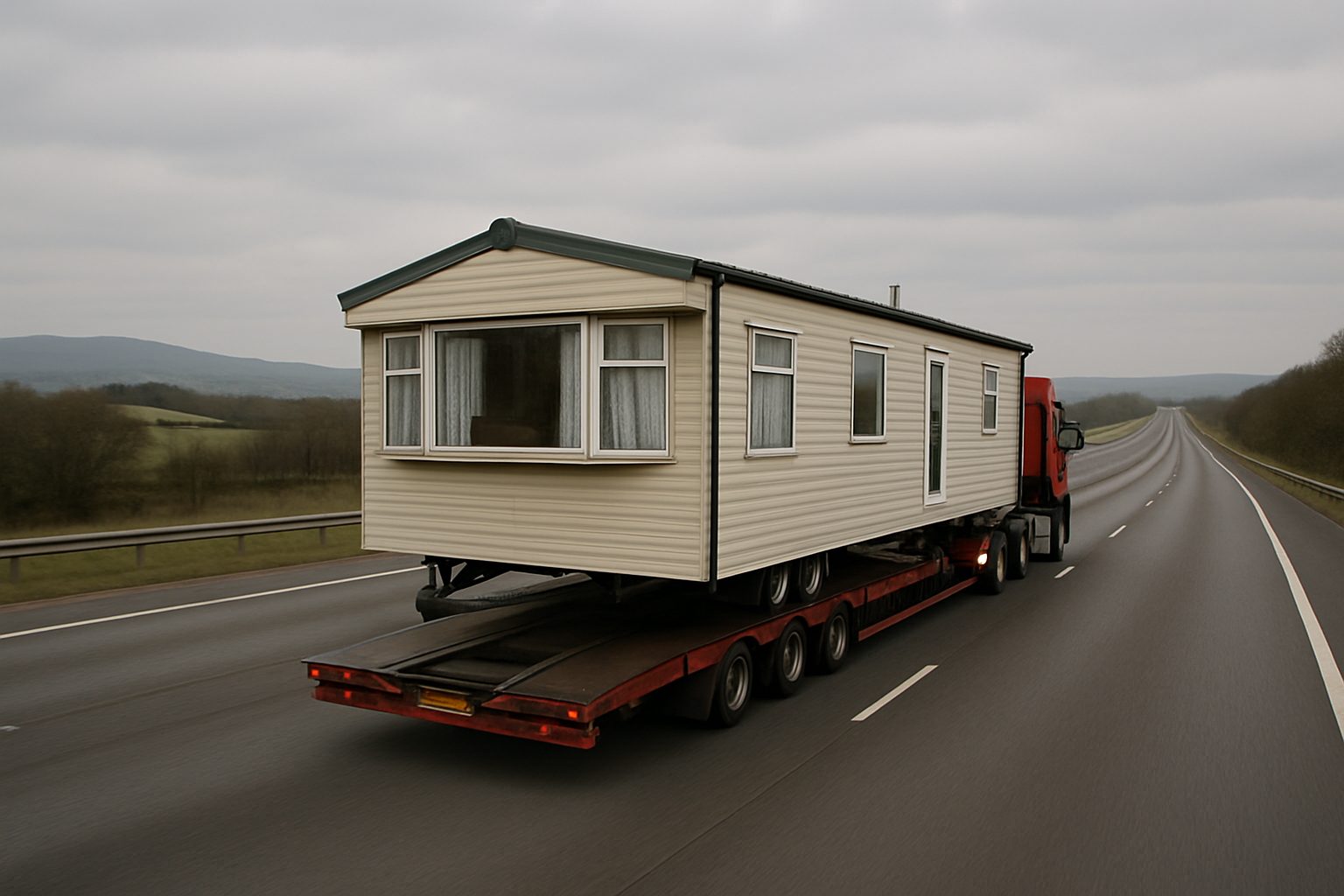
Moving a static caravan across the country sounds daunting – a heavy, wide load that can’t be towed, a route you’ve never driven, and a nagging worry about whether the lorry will even fit down the lane to your new pitch. Yet long-distance static caravan transport is a regular part of what specialist hauliers do every week. Whether you’re relocating from Kent to Cumbria, escaping rising pitch fees on the south coast, or delivering a newly purchased unit from a dealer in Yorkshire to a park in Wales, the logistics follow a well-established pattern – provided you use the right team.
Why long-distance moves are not one-off specials
A common misconception is that moving a static caravan a long way is unusual or especially expensive compared with a local move. In practice the biggest cost driver is the time it takes to de-site and re-site the unit, not the miles on the motorway. Fuel, permit fees, and driver time do increase with distance, but because Static Caravan Movers operates through a trusted national network of transport and siting teams across all of mainland UK, long-haul jobs are priced competitively and handled with the same processes as any other move. There is no “special surcharge” simply for crossing a regional boundary.
Transport pricing starts from £950 for most standard single-unit jobs. The total cost of your move will also include de-siting and re-siting, which typically runs from £300 to £1,200 for a standard single unit and from £4,000 to £5,000 for a large, twin-unit, or specialist home. Distance adds to the haulage element, but it rarely doubles the overall bill.
Why static caravans need specialist transport – however far they travel
A static caravan is not a touring caravan. It cannot be towed behind a vehicle; it must be carried on a specialist low loader with the correct axle configuration, tie-down points, and height clearance. Most single units are 10–12 ft wide and 28–40 ft long, weighing several tonnes – dimensions that place them firmly in the abnormal load category the moment they leave the park entrance.
What makes the long-distance version more complex is the sheer number of police districts, bridge authorities, and highway bodies the route passes through. Every one of them must be notified in advance via the ESDAL (Electronic Service Delivery for Abnormal Loads) system. For loads over approximately 2.9 m wide – which covers virtually every static caravan – that notification must be submitted at least two clear working days before the journey begins. Loads over roughly 3.5 m wide usually require an escort vehicle front and rear; those over 5 m may need National Highways consent and, in some cases, a police escort. Read more in our guide to abnormal load permits and escorts.
Static Caravan Movers handles all of this: ESDAL submissions, route planning, marker boards, pilot vehicles, and any consent applications. You do not need to understand the permit system – just tell us the origin and destination.
What happens on a long-distance move: step by step
- Survey and quote. We gather the caravan’s dimensions, current park location, and destination. We check access at both ends – gate widths, road surfaces, overhead cables, tree canopies – because a site visit (or detailed photos) at this stage avoids surprises on move day.
- Route planning and permits. Our team plans the optimal route, calculates load category, submits ESDAL notifications to every police force and highways authority along the way, and confirms the two-clear-working-day window before travel.
- You arrange utility disconnection. Gas, water, and electricity must be disconnected and signed off by a suitably qualified professional before the unit is moved. Some parks insist that only their own staff may disconnect services. Either way, this is the owner’s responsibility to arrange. Skirting and decking removal is also usually the owner’s task, though we can quote for it if needed.
- De-siting. On the agreed date, our team jacks the unit off its stands, removes it from the pitch, and loads it securely onto the low loader. Read about the de-siting process in detail.
- Transport. The low loader travels the planned route. For very long journeys an overnight stop may be required; we build this into the schedule and quote. An escort vehicle travels alongside for wider units.
- Re-siting. At the destination, we position, level, and set the unit on its new pitch. For a twin-unit home we transport each half separately and rejoin them on site, resealing all weather-exposed joints. We can also refit skirting and steps on request.
- You arrange utility reconnection. Again, a qualified professional must reconnect and sign off gas, water, and electricity before the unit is occupied. We do not carry out certified utility connections and are not liable for them – but we can point you to the Caravan Disconnect & Reconnect page for context.
Access: the question that catches people out
On a short local move the driver may know the destination park well. On a long-distance move they almost certainly do not. Access problems – a tight bend on a private road, a weight-restricted bridge, low-hanging power cables, or a park entrance that was widened but never updated on mapping data – are the most common cause of delays and additional costs on any static caravan transport job, long or short.
Before confirming your booking, share as many details as you can about both the departure pitch and the receiving pitch:
- Entrance gate width and height clearance
- Surface type on the internal road (tarmac, gravel, grass)
- Any weight restrictions on the approach road or a bridge
- Whether there are overhead utilities crossing the route into the pitch
- The pitch number and whether the site manager will be available
Our team will cross-reference this against our route assessment. Being thorough here protects your budget and keeps the move on schedule. See also our guide on how static caravans are transported for more on what the low loader and crew need to work with.
Reasons people move a static caravan long distance
Long-distance moves are more common than you might expect. The most frequent reasons include:
- Pitch fees rising sharply. Annual site fees across UK holiday parks run from around £3,000 to well over £12,000. If your park has increased fees significantly, relocating to a more affordable park – even one several hundred miles away – can recoup the transport cost within a single season. See our guide on when rising pitch fees make a move worthwhile.
- Site closure or eviction. When a park closes or revokes a licence, owners often need to find a new pitch at short notice, sometimes far from the original location. Read our guide on moving after a site closure.
- Age limits at the current park. Many parks enforce age limits of 10–20 years. If your unit is approaching that limit but is still structurally sound – static caravans can last 15–30+ years with proper maintenance – moving it to a park with a more flexible policy is often more economical than buying new.
- Change in personal circumstances. Retirement, a change in family situation, or simply wanting a coastal park in a different part of the country are all common drivers.
- Buying a unit at a distance. Purchasing a second-hand static caravan from a seller in another region often requires long-distance delivery to your chosen park.
- Moving to private land. Some owners relocate to private land they own or lease, which may be anywhere in the country.
What a long-distance move costs: a realistic guide
Every move is priced individually because the variables are significant. The table below gives a realistic framework based on typical single-unit moves. Twin-unit and specialist homes will cost more. All figures are estimates; contact us for an exact quote.
| Cost element | Typical range | Notes |
|---|---|---|
| Transport (haulage) | From £950 | Starting figure for most standard single-unit jobs; increases with distance, width, and escort requirements |
| De-siting | £300–£1,200 (standard); £4,000–£5,000 (twin-unit / specialist) | Jacking, lifting, removal from pitch |
| Re-siting | Included in de-siting figure above | Positioning, levelling, rejoining twin-units, making watertight |
| Escort vehicle(s) | Included in our quote where legally required | Required over approximately 3.5 m wide; wider loads may need two escorts |
| ESDAL notifications & permits | Included in our quote | We handle all route notifications across every police district |
| Utility disconnection / reconnection | Arranged and paid by the customer | Must be carried out by a suitably qualified professional |
| Skirting / decking removal | Typically arranged by the customer | We can quote if required; adds time and cost |
For a detailed breakdown of all the factors that affect price, see our full UK cost guide for moving a static caravan.
Twin-unit homes on long-distance moves
A twin-unit park home or residential static is two separate halves joined together on site. For transport, each half is loaded independently onto its own low loader and driven in convoy or on consecutive days. At the destination the two halves are positioned, levelled, bolted together, and all joints are resealed to make the home watertight before you move back in.
Because each half is its own abnormal load, the permit and escort requirements apply twice over, and the siting work at both ends is more involved. This is reflected in the cost (£4,000–£5,000 is a typical range for siting a twin-unit). If you own a twin-unit home, be sure to mention this when you request a quote. See our dedicated guide to moving a twin-unit static caravan for a full explanation.
Planning ahead: timelines and booking
Long-distance moves need more lead time than local ones, for straightforward reasons:
- ESDAL notifications for multi-district routes must be filed at least two clear working days before the journey, and complex routes with National Highways consent may require longer.
- Securing a transport team and low loader across two distant regions requires coordinating diaries, sometimes weeks in advance during peak season (typically April to September).
- Your receiving park may have restricted access windows for deliveries – always confirm these with the park manager before booking transport.
- You need time to arrange certified utility disconnection at origin and reconnection at destination.
As a general rule, allow at least two to four weeks from enquiry to move day for a straightforward long-distance single-unit transport, and longer for twin-units or moves involving complex routes or tight site access. Our guide on how long it takes to move a static caravan covers the full timeline in detail.
Frequently asked questions
How far will you transport a static caravan?
We cover all of mainland UK. Whether you need a move from East Sussex to Northumberland or from the Scottish Borders to Devon, we can price and manage the job through our national network. There is no maximum distance; the quote simply reflects the haulage time and any additional permit requirements for the route.
Do I need to be present for the move?
It is strongly advisable to be present – or to have a trusted representative on site – at both the departure and arrival pitches. The site manager at each park will usually need to be available too, particularly to manage gate access and to confirm pitch location. At the delivery end, someone needs to sign off that the unit has been positioned to satisfaction before the crew leaves.
Who disconnects the gas, water, and electricity?
This is always the customer’s responsibility to arrange. Disconnection and reconnection of gas, water, and electrical supplies must be carried out and certified by a suitably qualified professional – a Gas Safe registered engineer for gas, and a qualified electrician for the electrical supply. Some parks require that only their own maintenance team may disconnect services; check your site licence or speak to your park manager well in advance. Static Caravan Movers does not carry out certified utility connections and is not liable for them.
Will my caravan be insured during transport?
Professional static caravan transporters carry goods-in-transit and public liability insurance that covers the unit during the move. You should check the cover limits with us at quote stage and confirm whether your own caravan insurance policy requires you to notify your insurer of the move. Our guide on static caravan transport insurance covers what to look for.
What if my new park has age restrictions?
Park age limits – commonly 10, 15, or 20 years depending on the park – are enforced by the park operator, not by us. Before committing to a long-distance move, confirm with the receiving park that your caravan’s age and condition meet their requirements. Moving a caravan only to have it refused at the gate is an expensive mistake. Many parks will carry out a condition survey before granting permission to bring a unit on site.
Does the caravan need to be emptied before transport?
Yes. All loose furniture, crockery, kitchen contents, and personal belongings should be removed or securely fixed before transport. Gas cylinders must be removed or isolated. Cupboard doors should be taped shut and any fragile fittings protected. Our preparation checklist walks you through everything that needs doing before the low loader arrives.
How long does a long-distance move actually take on the road?
Abnormal loads travel at restricted speeds and may be limited to certain time windows – many wide-load movements avoid peak commuter hours or require night travel on busy urban roads. A move from the south-east to the north of Scotland, for example, may involve a two-day journey with an overnight stop, all built into the planning and the quote. The siting work at each end adds further time – typically half a day to a full day per site, longer for twin-units.
Do I need to inform my current park that I’m moving?
Yes – and usually well in advance. Check your pitch agreement for any notice period (commonly one to three months). Some parks have clauses about how a unit must be left after removal, including reinstating the pitch surface. Failing to give proper notice can result in additional charges or complications with recovering any deposit. It’s also courteous to give the park manager enough time to re-let your pitch.
Related guides & services
- How to Move a Static Caravan to Another Site: Step-by-Step UK Guide
- Static Caravan Abnormal Load Permits & Escorts Explained (UK Law)
- How Much Does It Cost to Move a Static Caravan? UK Price Guide 2026
- Moving a Twin-Unit Static Caravan: How It Works
- Pitch Fees Rising? When to Move Your Static Caravan
- Static Caravan Transport service