
Receiving notice that your holiday park or residential site is closing – or being told your pitch agreement is being terminated – is one of the most stressful situations a static caravan owner can face. The clock is ticking, your home or holiday retreat is fixed to a pitch, and suddenly you’re having to think about legal rights, removal timescales, new site availability, and transport logistics all at once. This guide walks you through exactly what happens, what you need to arrange, and how to get your caravan moved safely when a site closure forces your hand.
Why Site Closures Happen – and What Notice You Should Get
Parks close or evict owners for a range of reasons: planning permission expiry, redevelopment of the land, change of ownership, financial difficulties, or a decision by the operator to stop running a residential or holiday park. The legal protection you have depends heavily on whether your park is a residential (year-round, BS 3632) or a holiday (seasonal) site, and on what your pitch agreement says.
Residential park home residents have significant statutory protection under the Mobile Homes Act 1983 (as amended). A site owner cannot end a residential pitch agreement without a court order, and they must show specific legal grounds to do so. If the site is being closed entirely, residents are entitled to proper notice and, in many cases, compensation. Holiday caravan owners have weaker statutory rights – their position is primarily governed by their pitch licence agreement as a contract rather than by statute – though Part 2 of the Consumer Rights Act 2015 does protect against unfair terms. In practice, a 28-day notice period before removal is commonly specified in holiday park agreements, though terms vary. If you’re unsure of your rights, Citizens Advice or a solicitor specialising in mobile homes can advise before you commit to any transport booking.
Whatever the legal position, the practical reality is the same: at some point your caravan needs to leave the site. And once you know that, it pays to start planning the move as soon as possible.
Your First Decision: Move It or Sell It?
Before booking a transporter, think through your options:
- Move to a new site – the most common choice if the caravan is relatively modern and in good condition. See our guide on moving a static caravan to another site: UK rules explained for the key checks involved.
- Move onto private land – possible in some circumstances but planning permission and site licensing rules apply. Read can you move a static caravan onto private land? before assuming this is straightforward.
- Sell in situ before moving day – if the closure notice gives you enough time, selling to a dealer or private buyer who arranges their own transport can save you the cost of the move. See selling a static caravan: your options explained.
- Scrap or donate – older units that have exceeded a destination park’s age limit may have no realistic new home. Some dealers or charities will take them; others will quote for strip-and-scrap on site.
The age-limit question catches many owners out. Most holiday parks enforce a 10–20-year age limit on incoming units, and residential parks often apply similar rules. A caravan that is 18 years old and perfectly liveable may be refused by every park within driving distance. If that applies to your van, it’s better to know now, before spending £950 or more on transport, than to find out on arrival day.
Understanding the Transport Process
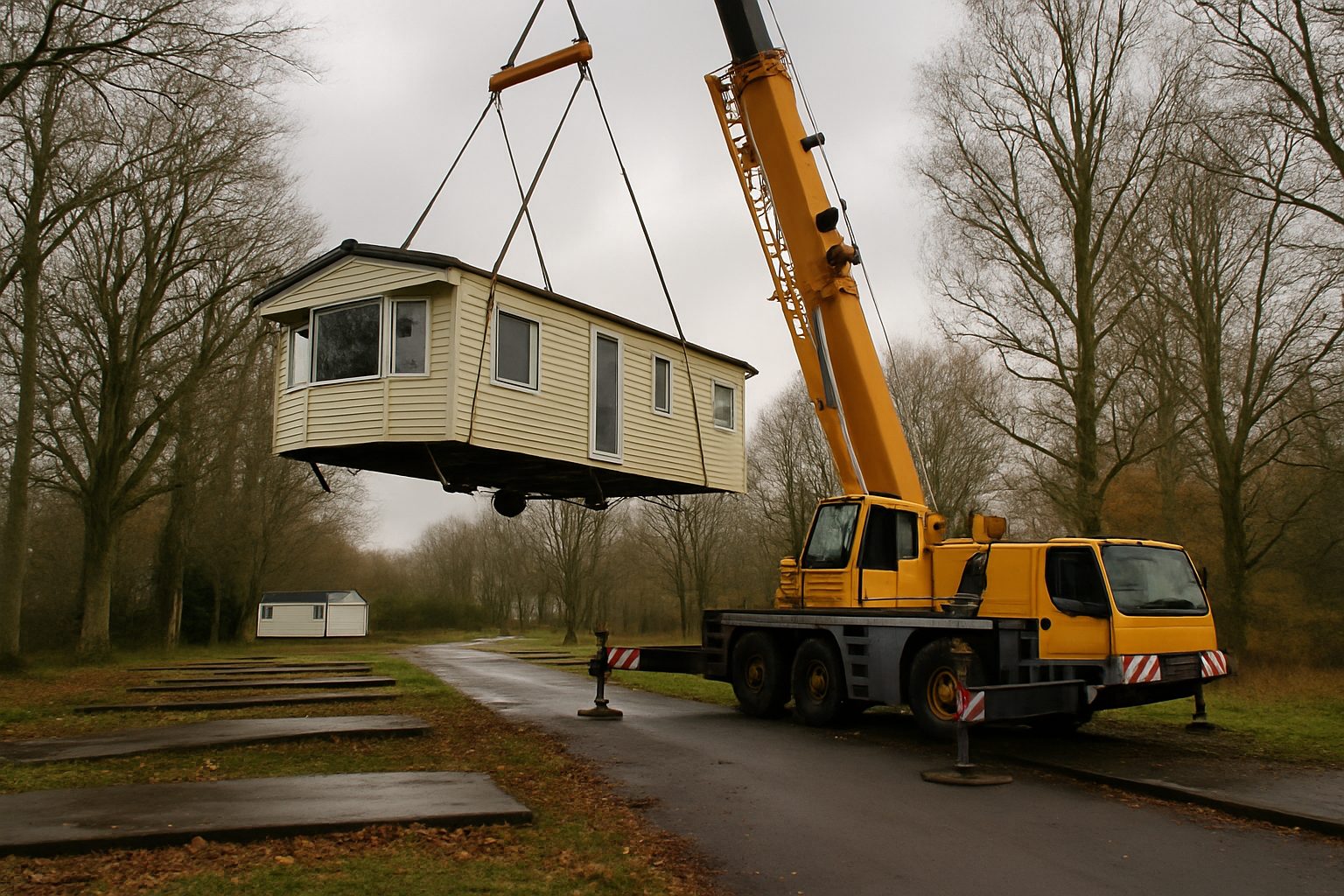
Static caravans cannot be towed with a domestic vehicle – they are not touring caravans. They are carried on specialist low-loader trailers. Because most single units are 10–12 feet (around 3–3.65 m) wide, and many twin-unit park homes split into two halves each of similar width, virtually every move involves abnormal load regulations. Read the full detail in our guide to how static caravans are transported, or see what our static caravan transport service includes.
In brief, the rules work like this:
- Any unit over approximately 2.9 m wide requires ESDAL notification to the relevant highway authorities – you need at least two clear working days’ notice before moving.
- Units over roughly 3.5 m wide typically require a formal escort vehicle to accompany the low loader.
- Very wide loads (over 5 m) may require National Highways consent or police notification.
- All loads need prescribed marker boards and lighting; moves are usually restricted to daytime and may be banned on bank holidays or during peak-traffic periods.
Static Caravan Movers handles every element of this: ESDAL notifications, route planning, marker boards, and sourcing escort vehicles where required. You don’t need to organise permits yourself. See our dedicated guide on abnormal load permits & escorts explained for more.
What You Need to Arrange Before Transport Day
The single biggest source of delays and additional costs in a site-closure move is utilities. This is important: Static Caravan Movers does not carry out gas, water or electrical disconnection or reconnection, and we are not liable for those works. The certified disconnection of services must be done by a suitably qualified professional – a Gas Safe registered engineer for gas, a qualified electrician for electrics, and a plumber for water. Some parks insist that only their own contractors may disconnect from the park’s supply; check your pitch agreement and speak to the park manager before booking anyone independently.
Aside from utilities, here is a checklist of what needs to happen before the low loader arrives:
- Confirm your destination pitch is ready – hard standing prepared, site licence in place, park accepts the unit’s age and dimensions.
- Arrange certified gas, water and electrical disconnection – get sign-off documentation.
- Remove or arrange removal of skirting and decking – usually the owner’s responsibility; we can quote to include this but it adds time and cost.
- Clear and secure the interior – remove all loose items; secure anything fixed that could move in transit.
- Drain water from tanks and pipes – even a small amount of standing water adds weight and can damage the unit if it moves during transport.
- Confirm access for the low loader – width and height of the park entrance, any overhead cables or barriers, surface condition of the access road.
Our full checklist for preparing a static caravan for transport covers each of these points in detail.
The Access Question: Can the Lorry Actually Reach the Pitch?
This is one of the most common practical problems in site-closure moves, and it is worth raising with us at the quote stage rather than discovering it on the morning of the move. Low-loader trailers are long – typically 13–16 metres overall – and need a reasonable turning radius and a reasonably firm surface to manoeuvre. Problems that regularly cause delays include:
- Park entrances with height barriers or width restrictions installed after the caravan was originally sited
- Overhead power or telephone lines crossing the access route at low height
- Narrow internal roads between pitches, particularly on older parks developed before larger units became common
- Soft or waterlogged ground after a wet winter
- Other static caravans that have already been removed, leaving soft infill that won’t support the lorry’s weight
When you contact us, give us the postcode and pitch number and we will do a route check as part of the quote process. If there are access complications, we will tell you upfront rather than charging extra on the day.
How Much Does It Cost?
Transport of a single static caravan starts from £950 with Static Caravan Movers for most jobs. The exact figure depends on the size and weight of the unit, the distance, whether an escort vehicle is required, and the access conditions at both ends. Twin-unit homes – moved as two separate halves and rejoined on site – cost more because they require two transport movements and a full rejoining and resealing operation at the destination. For a detailed breakdown, see our UK price guide to moving a static caravan.
De-siting (lifting, disconnecting from stands, and preparing for loading) and re-siting (levelling, positioning and making watertight at the new pitch) are typically priced separately. For most single units this ranges from £300 to £1,200, rising to £4,000 to £5,000 for larger, twin-unit or otherwise complex homes. The table below gives a rough guide:
| Unit type | Transport (from) | De-site & re-site (approx.) |
|---|---|---|
| Single static, standard width, short haul | £950 | £300–£600 |
| Single static, standard width, long haul | £950+ | £300–£600 |
| Single static, wide/heavy or escort required | Price on application | £600–£1,200 |
| Twin-unit park home (two halves) | Price on application | £4,000–£5,000 |
Remember that certified utility disconnection and reconnection, and skirting/decking removal, are additional costs you will need to budget for separately. We can often recommend trusted local tradespeople at the destination end if you need a starting point.
How Long Will the Move Take to Organise?
The minimum realistic lead time from first contact to transport day is usually two to three weeks for a straightforward single unit, assuming your destination pitch is confirmed and utilities can be disconnected in time. The main constraints are:
- ESDAL notification requires at least two clear working days’ notice before the move date – this cannot be shortened.
- Police or National Highways consent for very wide or heavy loads can add further lead time.
- Availability of qualified trades to disconnect utilities – Gas Safe engineers are often booked two to four weeks out, so start this process early.
- Destination park readiness – even if your new pitch exists on paper, the standing has to be prepared before the lorry can site the van.
If your site closure notice gives you less than three weeks, contact us immediately. We will do everything on our side as quickly as the regulations allow, but the utility and permit timescales are fixed. For a fuller explanation of typical timescales, see how long does it take to move a static caravan?
Long-Distance Moves After a Site Closure
Site closures sometimes force owners to move further than they would choose – either because the nearest available pitch is a long way from the closed park, or because the owner takes the opportunity to relocate entirely. Static Caravan Movers covers all of mainland UK through a trusted national network of transport and siting teams, which means even moves from South-East England to Scotland, Wales or the North-West are priced competitively rather than treated as one-off specials. See our guide on long-distance static caravan transport across the UK for what to expect from an extended-haul move.
Frequently Asked Questions
Do I have to move my caravan if the park closes?
If your pitch agreement is being validly terminated and the site is closing, you will ultimately need to remove your caravan. Residential park home residents have the strongest legal protection – a court order is required to end your agreement and the process can take months. Holiday caravan owners generally have rights under their pitch licence agreement and the Consumer Rights Act 2015, but statutory protection is weaker. Take legal advice if you believe the termination notice is not valid before you commit to moving costs.
Can I move my static caravan to any park I choose?
Broadly yes, provided the receiving park will accept your unit and the unit complies with any planning or site licence conditions at the new location. Most parks impose age limits – commonly 10 to 20 years for incoming holiday caravans – and some have minimum specification requirements for residential units (such as BS 3632 compliance). Confirm the age limit and specification requirements with your intended new park before booking transport. See also our guide on moving a static caravan to another site: UK rules explained.
Who arranges the disconnection of gas, water and electricity?
You do – or rather, you arrange for suitably qualified professionals to do it. Gas disconnection must be carried out by a Gas Safe registered engineer; electrical disconnection by a qualified electrician. Some parks require that only the park’s own staff disconnect from the park supply, so check your pitch agreement before engaging anyone independently. Static Caravan Movers does not carry out certified utility connections or disconnections and is not liable for them. If you also use our caravan disconnect & reconnect service we can advise on the process, but certified sign-off must come from a qualified trade.
How quickly can you move a caravan once I have notice of site closure?
We can often turn around a quote within 24 hours of you contacting us. The minimum lead time for the move itself is driven by the ESDAL notification requirement – a minimum of two clear working days before moving an abnormal-width load – and by how quickly utilities can be disconnected and a destination pitch made ready. In practice, most moves from first enquiry to transport day take two to three weeks. If you have a very tight deadline, call us on 01797 740231 as early as possible and we will work with you on scheduling.
What if my caravan is too old or wide for any nearby park?
If age limits or specification requirements rule out every realistic destination, you may need to consider selling the unit (possibly to a dealer who will strip it for parts or materials), or scrapping it. Some dealers will offer a “buy and remove” service, taking the unit off site at their own cost in exchange for ownership. A caravan that has no onward home is not necessarily worthless; it’s worth making a few calls to local dealers before assuming you will have to pay for removal. Our guide to selling a static caravan covers the main routes.
Do you move twin-unit park homes after site closures?
Yes. Twin-unit homes are moved as two separate halves on two separate transport movements, then rejoined and resealed on the new pitch. This is a more involved process than moving a single unit – de-siting, transport, re-siting and rejoining a twin unit typically costs between £4,000 and £5,000 – but it is a standard part of our service. See our dedicated guide on moving a twin-unit static caravan for a step-by-step explanation.
Will my static caravan be insured during transport?
Your existing static caravan insurance policy may not automatically cover transit. Before the move, check with your insurer whether transit is included or whether you need a separate policy. Our guide to static caravan transport insurance explains what to look for and what a specialist transit policy typically covers.