
You’ve decided to move your static caravan – or it’s been moved on by the park – and now you need to understand exactly what happens between the moment the unit is still sitting on its pitch and the moment a low loader pulls away with it. The de-siting process has more steps than most owners expect, and knowing what each one involves helps you book the right people, avoid delays, and keep control of the costs.
What de-siting actually means
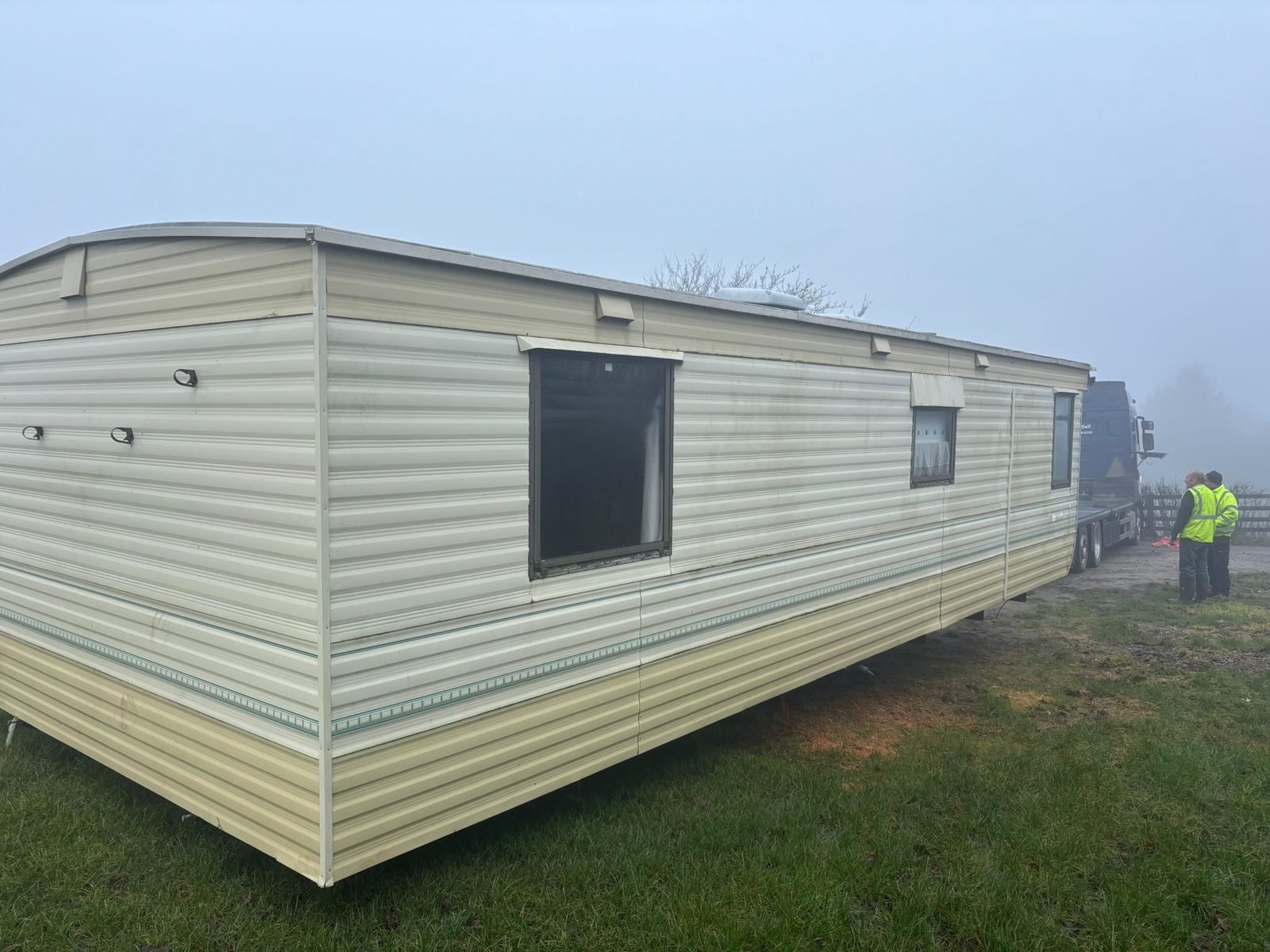
De-siting is the physical process of removing a static caravan or park home from its pitch. It is the mirror image of siting: the unit has to be lifted off its permanent supports, manoeuvred to the road edge, and loaded safely onto a specialist low-loader vehicle. Unlike a touring caravan, a static cannot simply be hitched up and driven away – it is designed to sit on a pitch indefinitely, resting on axle stands or concrete blocks, and getting it moving again takes equipment, skill, and in many cases advance notice to the authorities. For a full explanation of why statics need specialist transport, see our guide on why statics need specialist transport. Our static caravan transport service covers de-siting, haulage and re-siting as a single job.
Step-by-step: the de-siting process
The exact sequence can vary slightly depending on the pitch, the unit, and the park’s own requirements, but the following covers how a typical de-site unfolds.
1. Utility disconnection – arranged by you
Before any physical work starts, the gas, water, and electrical supplies to the unit must be disconnected and signed off by a suitably qualified professional. This is work that you – the owner – must arrange independently. Static Caravan Movers does not carry out certified utility disconnection and is not liable for it.
Worth noting: many holiday and residential parks insist that only their own maintenance team or an approved contractor is permitted to disconnect the utilities on site. Check your pitch licence agreement well in advance – some parks quote several weeks’ lead time for this work, and some charge a separate disconnection fee of several hundred pounds. If you’re unsure what’s included in the park’s quote, ask them to itemise it. Our caravan disconnect & reconnect service page explains what suitably qualified work looks like at both ends of a move.
2. Skirting, decking, and external fixings
Skirting panels, timber decking, steps, and any attached outbuildings need to come off before the lifting equipment can get under the chassis. In most cases this is arranged by the owner – either by doing it yourself or hiring a local contractor. We can price skirting removal as part of the job, but it adds time and cost, so it’s usually faster if it’s completed before our team arrives.
3. Access survey and low-loader positioning
Our team will have assessed the route to your pitch at the quoting stage – this is one of the most common causes of delay when owners book without thinking it through. A low-loader is a long, wide vehicle. Tight park roads, overhead cables, sharp bends, soft ground, and low barriers can all require extra planning. For narrow or difficult access, a 4×4 may be used to pull the unit to a more accessible loading point before the low-loader takes over. Tell us about any access restrictions at the point of enquiry so we can allow for them properly.
4. Jacking and lifting off the supports
Once access is clear and utilities are confirmed disconnected, the physical de-siting begins. Using hydraulic jacks, our team raises the unit off its axle stands or concrete blocks – typically jacking one side at a time along the main chassis members. This must be done carefully and evenly: an unbalanced lift risks structural stress to the floor frame. Corner steadies are lowered to assist stabilisation during the lift but are not used as primary load-bearing supports at any stage.
5. Removing the supports and preparing the chassis
With the unit raised, the axle stands, blocks, and any chassis packing are cleared away. The chassis is inspected before loading – any obvious structural issues or corrosion that could affect how the unit sits on the low-loader are noted at this stage. Windows are secured, any loose fittings inside are checked, and the unit is prepared for road transit in line with our static caravan transport preparation checklist.
6. Loading onto the low-loader
The unit is winched or pushed up the ramps of the specialist low-loader, then secured with chains and straps to the vehicle bed. Because static caravans are wide – typically 10–12 feet (roughly 3–3.7 m) – most moves qualify as abnormal loads under UK road regulations. Static Caravan Movers handles all ESDAL notifications, route planning, marker boards, and escort vehicles where required. Units over approximately 2.9 m wide require two clear working days’ notice via the ESDAL system; those over approximately 3.5 m typically need an escort vehicle; wider or heavier loads may need National Highways consent or police involvement. See our abnormal load permits guide for a full breakdown. For detailed information on dimensions and what triggers each category, visit our static caravan sizes, widths & weights guide.
7. A note on twin-unit homes
Twin-unit park homes are two separate halves joined on site. De-siting them means first breaking the join – separating the structural connection, re-sealing the open ends of each half, and loading them as two individual moves. This significantly increases both the time and cost. Our twin-unit static caravan moving guide covers this in detail.
What the de-siting service costs
De-siting and re-siting costs vary considerably depending on unit size, pitch conditions, and how much dismantling is involved. As a general guide:
| Scenario | Typical cost range |
|---|---|
| Standard single-unit de-site & re-site | £300 – £1,200 |
| Larger, heavier, or more complex single unit | £1,200 – £2,500 |
| Twin-unit or specialist park home | £4,000 – £5,000 |
| Transport (all moves, starting from) | £950 |
These figures cover the lifting, positioning, levelling, and making the unit watertight at the destination. They do not include utility reconnection (arranged by you), skirting removal (usually customer-arranged), or park charges. For a complete picture of total move costs, see our static caravan move cost guide.
What you need to arrange before we arrive
To avoid delays on the day, the following need to be in place before our team gets to the pitch:
- Gas, water, and electrical supplies disconnected and signed off by a qualified professional (gas – Gas Safe registered; electrical – Part P or equivalent). Check whether your park insists on using their own contractor.
- All outstanding pitch fees and park charges settled – most parks will not release a unit until the account is clear.
- Skirting, decking, and steps removed or priced separately and confirmed with us in advance.
- Any personal belongings and loose items secured or removed from inside the unit (a full checklist is in our preparation guide).
- Park management informed of the removal date – some parks require written notice and have their own removal procedures.
- Access route to the pitch confirmed as clear for a low-loader on the day.
Common reasons for a de-site
People arrange de-sites for all sorts of reasons, and the logistics are largely the same regardless of which applies to you:
- Moving to another park – upgrading to a newer pitch, relocating closer to family, or responding to a park’s age limit notice. See our guide on moving to another site for what to check before committing.
- Site closure or eviction – not always planned. If a park is closing or you’ve been served notice, acting quickly on transport matters. Our guide on moving after site closure covers your options and timescales.
- Placing the unit on private land – subject to planning permission rules. See static caravan on private land: rules & planning.
- Selling the unit – a buyer has found a pitch and needs the unit delivered. This is covered in our delivery & collection service.
- Pitch fee increases – a prolonged pattern of above-inflation rises. Our guide on whether rising pitch fees justify a move helps you work out the numbers.
How long does a de-site take?
For a standard single-unit de-site in good conditions with utilities already disconnected and skirting already removed, the physical lifting and loading typically takes two to four hours on site. Add the transport journey and re-siting at the other end, and most single-unit moves complete within one day. Twin-units, difficult access, or complications at the destination can extend this to two days or more. Our how long does it take to move a static caravan guide goes through timings in more detail.
One often-overlooked timeline is the ESDAL notification window. Once we have confirmed your move and know the unit’s dimensions, we notify the relevant highway authorities. For most static caravans this requires two clear working days’ notice – so booking at the last minute can mean a short but unavoidable wait before the lorry can legally travel. Plan ahead if you have a hard deadline.
Frequently asked questions
Who is responsible for disconnecting the utilities before de-siting?
You, the owner. Gas disconnection must be carried out by a Gas Safe registered engineer; electrical disconnection requires a suitably qualified electrician (Part P competent person or equivalent). Water disconnection is usually simpler but should still be signed off. Many parks also insist that only their own approved contractor carries out this work, so check your pitch licence before booking an independent engineer. Static Caravan Movers does not carry out certified utility disconnection.
Can the park refuse to let me remove my static caravan?
A park can delay release if outstanding pitch fees or other charges remain unpaid, or if their removal procedures haven’t been followed – including the required notice period and use of approved disconnection contractors. They cannot, however, permanently prevent you from removing a unit you own. If you are dealing with a formal eviction or site closure notice, our moving after site closure guide covers your rights in more detail.
Do I need to be present on the day of the de-site?
It’s strongly advisable. You will need to confirm utilities are disconnected before work begins, deal with the park if any last-minute issues arise, and sign off the unit as loaded. If you genuinely cannot be there, make sure someone with authority over the unit is on site and that all the pre-checks (utilities, skirting, access, pitch fees) have been completed in advance.
What happens if the low-loader cannot reach the pitch?
Tight park roads, low barriers, sharp bends, or soft ground can all prevent a full-size low-loader from reaching a pitch directly. In these cases the unit is pulled or skidded to a more accessible loading point – sometimes using a 4×4 or smaller vehicle – before being loaded onto the low-loader at the park entrance or a nearby hard-standing. We assess access at the quoting stage, so tell us about any known restrictions when you enquire.
How much notice do I need to give the park before de-siting?
This varies by park and is set out in your pitch licence agreement. Many parks ask for four to twelve weeks’ written notice; some require less. Check your licence, notify the park in writing, and confirm their disconnection and removal procedures at the same time. The ESDAL notification for the transport itself requires at least two clear working days from our side, but the park’s own notice period is usually the longer constraint.
Does a twin-unit home cost more to de-site?
Yes, significantly. A twin-unit has to be separated into its two halves, each half sealed for transit, and loaded as two individual moves – which usually means two lorries or two separate loads. De-siting and re-siting costs for twin-units or larger park homes typically run from £4,000 to £5,000. See our twin-unit moving guide for what else to expect.
Do I need a permit to move a static caravan on the road?
In most cases, yes – because a static caravan is an abnormal load. Units over approximately 2.9 m wide require ESDAL notification at least two clear working days before the move. Those over approximately 3.5 m usually need an escort vehicle. Wider or heavier loads may require National Highways consent or police involvement. Static Caravan Movers manages all of this as part of the service – you do not need to arrange permits yourself. Full details are in our abnormal load permits guide.
Can I de-site a static caravan myself?
The physical lifting and loading requires specialist hydraulic equipment and a heavy goods vehicle with the correct configuration – this is not work that can be safely done with domestic kit. Beyond the equipment, there are legal requirements around abnormal load notifications and haulage licensing. The practical answer is no: de-siting must be carried out by a specialist transport and siting company.
Related guides & services
- Static Caravan De-siting & Re-siting service
- How to Move a Static Caravan to Another Site: Step-by-Step UK Guide
- How to Prepare a Static Caravan for Transport (Checklist)
- How Much Does It Cost to Move a Static Caravan? UK Price Guide 2026
- Static Caravan Abnormal Load Permits & Escorts Explained (UK Law)