
If you’re trying to move a park home or mobile home and you’re not sure who handles it, what it costs, or whether your home even qualifies as a “static caravan” – you’re not alone. The terminology is confusing, and the logistics are more involved than a standard removal. Static Caravan Movers has been transporting park homes and mobile homes across mainland UK for over 20 years, so this page sets out exactly what’s involved, what we handle, and what you’ll need to arrange yourself.
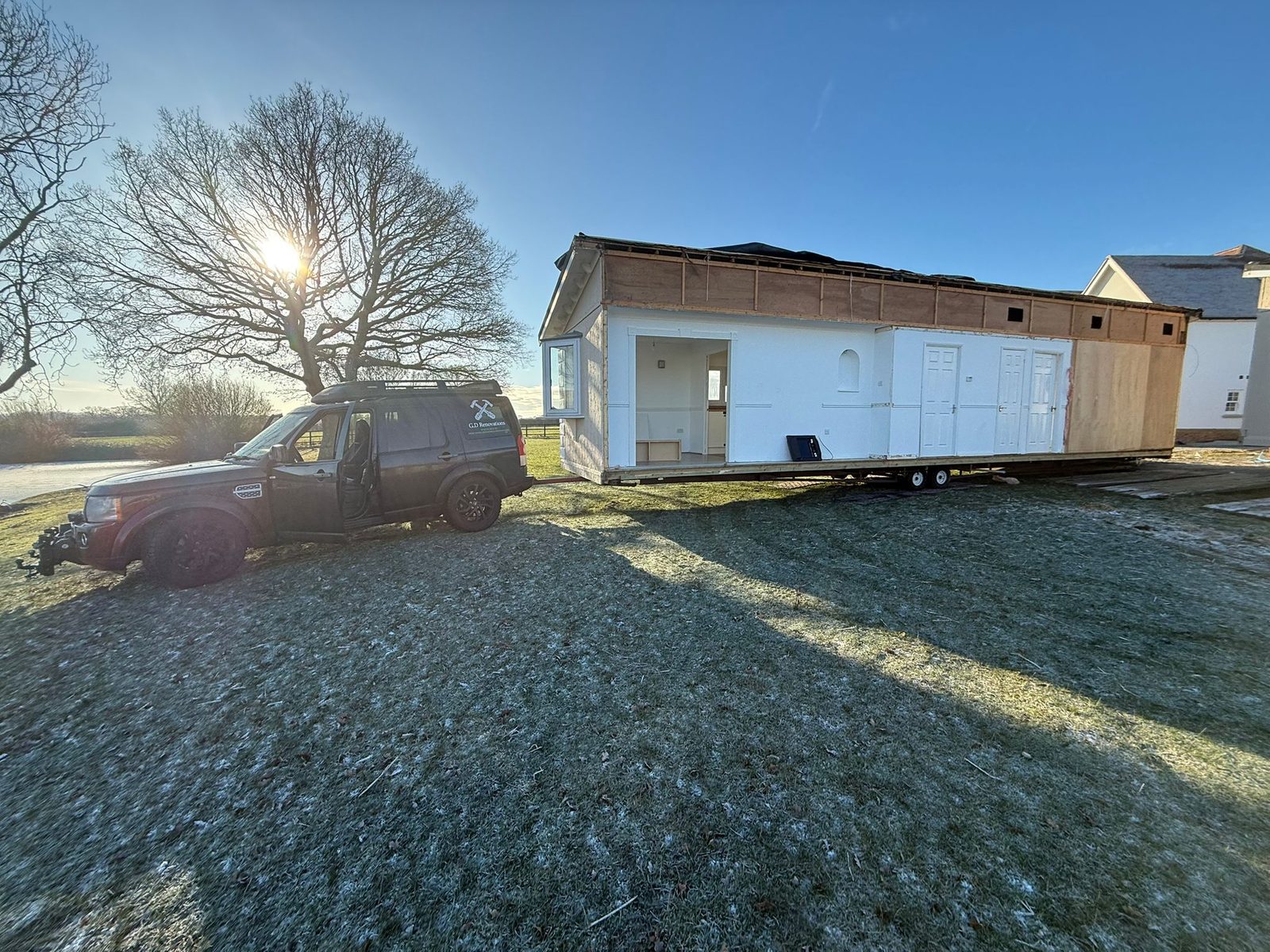
Park Home, Mobile Home, Static Caravan – What’s the Difference?
In everyday use these terms overlap, but there are meaningful distinctions. A static caravan is typically a leisure unit on a holiday park, built to standard EN1647. A park home (or residential mobile home) is built to the higher BS 3632 standard, is suitable for year-round living, and is protected under the Mobile Homes Act 1983. Both are transported in essentially the same way – on a specialist low-loader as an abnormal load – though residential park homes are often wider and heavier, which can affect permitting and cost. See our guide Static Caravan vs Park Home vs Mobile Home for a fuller comparison.
What We Cover
We transport and site single-unit and twin-unit park homes and mobile homes anywhere on mainland UK. Our national network means a move from Kent to Cumbria is priced competitively, not treated as an unusual special. Transport starts from £950 for most moves; siting and de-siting typically adds £300–£1,200 for a standard single unit, or £4,000–£5,000 for larger, twin-unit or specialist homes. For a detailed breakdown, see our guide to park home and mobile home moving costs. For holiday-home units, see our static caravan transport service.
Our transport and siting work includes:
- Specialist low-loader haulage – park homes cannot be towed, they must be carried
- All abnormal load paperwork: ESDAL notifications, route surveys, marker boards
- Escort vehicles where required (generally needed over approximately 3.5 m wide)
- National Highways consent and police liaison for the widest units
- De-siting: jacking, lifting and removing the unit from its existing pitch
- Re-siting: positioning, levelling on stands or axles, and making the unit level and stable
- Twin-unit moves: each half transported separately, rejoined and resealed on the new pitch
- Refitting skirting and steps on request
How the Move Works: Step by Step
- Free quote. Tell us the dimensions, current location and destination. We assess the route, permit requirements and access at both ends.
- Book & deposit. A 50% deposit reserves your move date. Balance is due when the unit is loaded.
- Utilities disconnected. Before we arrive, a suitably qualified professional must disconnect gas, water and electricity and sign off the work. Your park may insist only their approved contractor does this – check with them early. We do not carry out certified utility disconnections and are not liable for them.
- Skirting & decking removed. Usually arranged by you; we can quote to include it, but it adds time and cost.
- ESDAL notification filed. We submit the abnormal load notification at least two clear working days before the move (more for the widest units).
- Transport day. The unit is jacked, loaded on the low-loader and escorted along the pre-planned route.
- Re-siting. On the new pitch we position, level and – for twin units – rejoin and reseal. We refit skirting and steps if agreed.
- Utilities reconnected. Again, a qualified professional must reconnect and certify the services. We can point you to our Caravan Disconnect & Reconnect service page for further guidance.
Abnormal Load Permits: What You Need to Know
Park homes and mobile homes are almost always abnormal loads. Standard HGV road-legal width is 2.55 m – most residential park homes are 12 ft (approximately 3.7 m) wide, well above that threshold. This means ESDAL notification is mandatory, with at least two clear working days’ notice to police, highway authorities and relevant bridge owners along the route. Saturdays, Sundays and bank holidays do not count as clear days, so factor that into your planning.
Units over approximately 3.5 m usually need an escort vehicle front or rear. The very widest – some twin-unit halves exceed 5 m – may require National Highways consent and a police escort. We manage all of this. See our full guide to abnormal load permits & escorts if you’d like to understand the rules in more detail.
Access and Site Practicalities
One of the most common worries is access – can the low-loader actually reach the pitch? We survey the route as part of quoting, including overhead clearances, tight corners and road width. It’s worth telling us upfront about any narrow lanes, low bridges or restricted park gates. If the destination pitch is on private land, there are additional planning considerations to work through – our guide Can You Move a Static Caravan Onto Private Land? covers the rules.
Also worth checking before you commit: many residential parks enforce age limits on homes they’ll accept – commonly 10–20 years. If your park home is approaching that age, a destination park may decline it even after the move. Verify the park’s rules in writing before booking transport.
What You Need to Arrange
To keep the process clear, here’s what sits with you rather than us:
| Your responsibility | Notes |
|---|---|
| Gas disconnection & reconnection | Must be carried out and signed off by a Gas Safe registered engineer; some parks specify their own contractor |
| Electrical disconnection & reconnection | Must be carried out and certified by a qualified electrician (Part P or equivalent) |
| Water disconnection & reconnection | Qualified plumber; some parks handle this themselves |
| Skirting & decking removal | Typically arranged by you; we can quote to include it |
| Park & pitch permissions | Written consent from destination park; check their age limits and pitch dimensions |
| Buildings & contents insurance during transit | Check your policy; specialist transit cover may be needed – see our transport insurance guide |
We are not liable for certified utility connections – this is a legal requirement, not a preference, and your park or local council may require sign-off certificates before they allow reconnection.
Frequently Asked Questions
Can a park home or mobile home be towed like a touring caravan?
No. Park homes and mobile homes are too wide, too heavy and structurally unsuitable for towing. They must be carried on a specialist low-loader as an abnormal load. Our guide Can You Tow a Static Caravan? explains exactly why.
How much does it cost to move a park home?
Transport starts from £950. De-siting and re-siting a standard single-unit park home typically costs £300–£1,200 on top of that, depending on pitch access and complexity. Twin-unit or specialist homes run higher – typically £4,000–£5,000 for the siting work alone. Call us or use the quote form for a firm figure based on your specific home and route. See also: How Much Does It Cost to Move a Park Home?
How far in advance do I need to book?
ESDAL notification alone requires at least two clear working days (excluding weekends and bank holidays), but in practice you should book several weeks ahead. Popular move slots – particularly in spring and early autumn – fill quickly. Long-distance moves or those requiring police escorts need more lead time for route planning and consent applications.
Do you move twin-unit park homes?
Yes. Twin-unit homes are dismantled into their two separate halves, each transported on its own low-loader, then rejoined and resealed on the destination pitch. It’s a more involved operation and costs more than a single-unit move. Our guide Moving a Twin-Unit Static Caravan has the full detail.
Who disconnects the gas and electricity before the move?
You do – or rather, you arrange for a suitably qualified professional to do it. Gas disconnection must be carried out by a Gas Safe registered engineer; electrical disconnection must be certified by a qualified electrician. Some parks insist that only their own approved contractors may disconnect services, so check with your current park well before the move date. Static Caravan Movers does not carry out or certify utility connections and is not liable for them.
Do you cover the whole of the UK?
Yes – all of mainland UK. We’re based in Rye, East Sussex, but we operate through a trusted national network of transport and siting teams. A move from the south coast to Scotland is handled at the same competitive rate as a regional move – it’s not treated as a one-off. See Long-Distance Static Caravan Transport and our Areas We Cover page for more.
What if I’m being forced to move because my park is closing?
Site closures and evictions are stressful – timelines can be tight and you may have little warning. We’ve handled many urgent moves in exactly this situation. Get in touch as early as possible so we can secure a date and begin route planning. Our guide Moving Your Static Caravan After a Site Closure or Eviction covers your rights and the practical steps.