
Whether you’re thinking about placing a static caravan on your own land, buying a unit on a holiday park, or moving an ageing home to a new residential site, the same question comes up early: do you actually need planning permission? The honest answer is “it depends” – on how the caravan will be used, where it will sit, and who already holds the relevant consents. Get it wrong and you risk enforcement action, a forced removal, or a failed sale further down the line. This guide cuts through the confusion.
What the Law Actually Says
The key piece of legislation is the Caravan Sites and Control of Development Act 1960. It says that anyone who wants to use land as a caravan site must hold a site licence from their local council – and a site licence cannot be granted until planning permission already exists for that use. Planning permission and a site licence are therefore two separate but linked requirements: you need planning consent first, then the licence to operate.
Alongside this sits the standard Town and Country Planning framework. Placing a static caravan on land and using it in a way that represents a “material change of use” – turning a garden into a residential plot, or agricultural land into a holiday let – is development in the legal sense and requires permission. Simply owning a caravan and keeping it stored on your land, without using it as living accommodation, is a different matter entirely.
Buying a Pitch on an Established Park: Permission Already in Place
If you are buying or moving a unit onto an existing licensed holiday park or residential park, the planning permission already rests with the park operator – not with you as an individual owner. The park holds the site licence; you hold a pitch agreement. You do not make a separate planning application.
What does matter is whether the park’s planning consent and site licence cover your intended use:
- Holiday parks are typically licensed for recreational use only – a set season (often March to October or November) and a maximum number of weeks per year. You cannot use a holiday-park pitch as your permanent home address without breaching the park’s planning conditions. Some parks add their own age restrictions – commonly 10 to 20 years – which can affect whether a second-hand unit is even permitted on that site. Always check the licence conditions before you buy.
- Residential parks are licensed for year-round occupation under BS 3632, the standard for residential-grade park homes. These are the sites where people live permanently. The park still holds the planning consent; you benefit from it as a pitch occupier.
If you are considering a long-distance move between parks, it is worth reading our guide to moving a static caravan to another site alongside this one, as the rules on permitted uses interact with the practicalities of transport.
Placing a Static Caravan on Your Own Private Land
This is where most of the complexity – and most of the questions – arise. The short rule of thumb is:
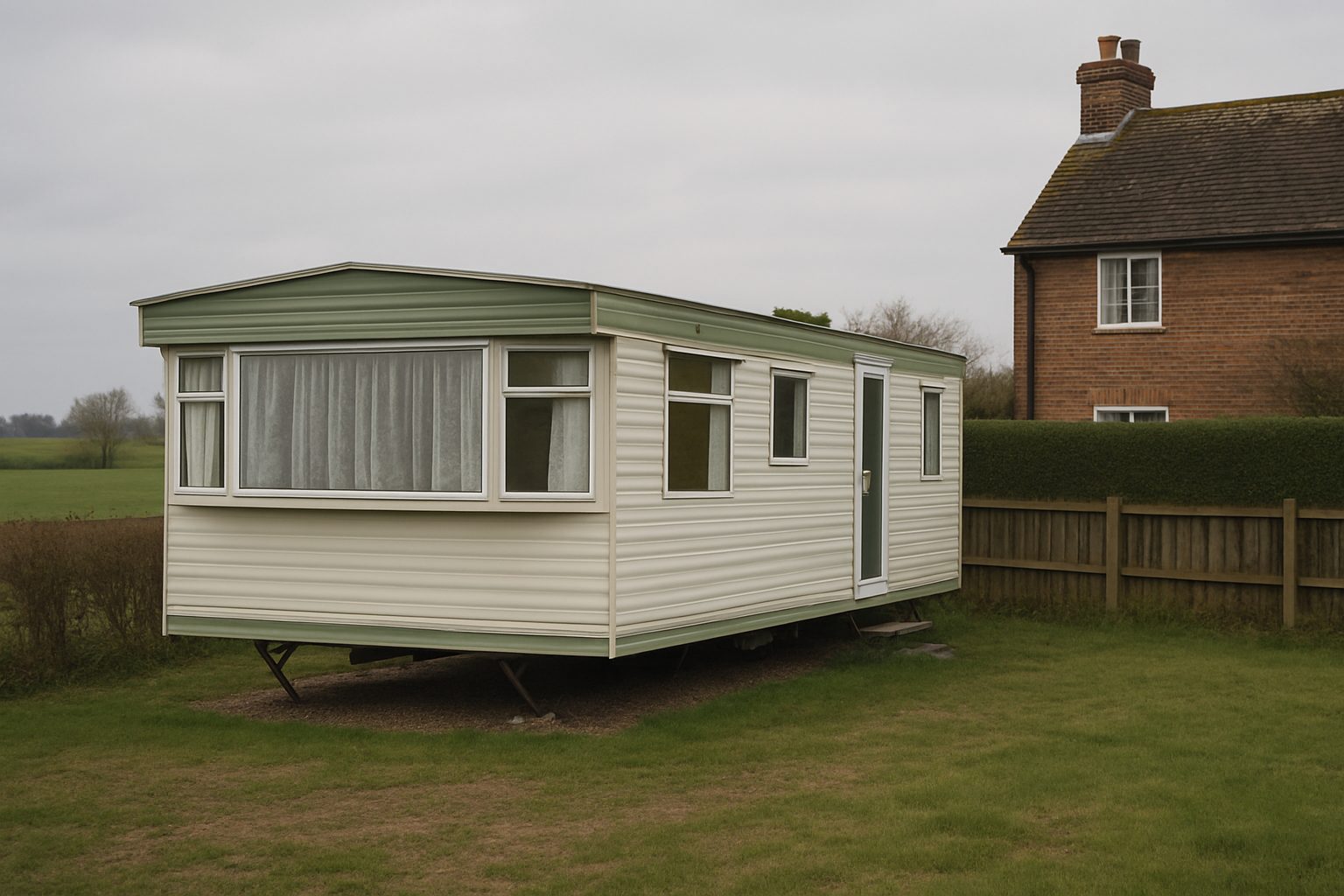
- Ancillary to your home, within the curtilage: planning permission is usually not required, provided the caravan is genuinely secondary to the main dwelling – for example, as occasional overflow sleeping space for family, not as a self-contained independent residence. The caravan must not be let commercially.
- As an independent residence (for you, a relative, or a tenant): this is almost always a material change of use and requires a full planning application.
- Commercial holiday letting on private land: this is a change of use to a commercial holiday use and requires planning permission in virtually every case.
- On agricultural or undeveloped land with no dwelling: planning permission is almost always required before you can site a caravan there, unless a specific agricultural worker or temporary-use exception applies.
Scotland, Wales and Northern Ireland each have their own devolved planning rules, and local councils across England vary considerably in how strictly they apply the guidance. Always check with your Local Planning Authority (LPA) before committing to a purchase or delivery – a pre-application enquiry costs little and can save a great deal of trouble. Our guide on placing a static caravan on private land goes into more detail on the residential and agricultural exceptions.
The 28-Day Rule: What It Does (and Does Not) Allow
You may have heard that a caravan can be placed on land for up to 28 days in any 12-month period without planning permission. This is a permitted development right under the Town and Country Planning (General Permitted Development) Order, and it is real – but limited. It applies to the temporary use of land, typically for camping or similar recreational purposes, and does not extend to connecting the caravan to permanent services or using it as a residence. It is not a route to long-term living or a commercial letting operation.
A Quick Reference: Common Scenarios at a Glance
| Scenario | Planning permission needed? |
|---|---|
| Buying a pitch on an existing licensed holiday park | No – park operator holds the consent |
| Buying a pitch on an existing residential park (BS 3632) | No – park operator holds the consent |
| Siting a caravan in your garden for ancillary family use (non-commercial) | Usually not – check with your LPA |
| Siting a caravan in your garden as an independent residence | Yes – material change of use |
| Placing a caravan on private land for commercial holiday letting | Yes – always |
| Placing a caravan on agricultural or undeveloped land as a dwelling | Yes – unless specific exception applies |
| Temporary placement under the 28-day permitted development right | No – but limited to 28 days/year, no services |
| Opening a new holiday or residential park | Yes – full planning application required |
Park Age Limits and What Happens When You Move
Even where planning is not your direct concern, a related issue catches many owners off guard: park age limits. Many holiday and residential parks impose a maximum caravan age – typically 10–20 years, though some premium parks run shorter windows. These are conditions set by the park operator (sometimes written into the site licence) rather than planning rules, but the effect is the same: a unit that has reached its age limit on one park may not be accepted on another.
If you are facing a site closure or an age-limit eviction, read our guide on moving your static caravan after a site closure or eviction. It is worth acting early, because finding an accepting park for an older unit takes time – and so does arranging specialist transport. Static caravans are not quick to move: they travel as abnormal loads on specialist low loaders, not on a towbar, and routes must be planned carefully.
What Comes After Planning: Practicalities of Siting
Once you have confirmed that planning permission exists – whether you hold it yourself or it sits with the park – the practical siting work can proceed. There are a few things to keep in mind:
Utility disconnection and reconnection
Gas, water, and electrical connections must be disconnected before a caravan can be moved, and reconnected and signed off at the destination by a suitably qualified engineer. This is the customer’s responsibility to arrange – some parks insist that only their own approved contractors carry out disconnection work. Static Caravan Movers does not carry out certified utility connections and is not liable for them. If you are unsure, speak to your park well in advance of the move date.
Skirting and decking
Skirting and decking usually need to be removed before the caravan can be lifted. This is typically arranged – and paid for – by the owner. We can price this work when quoting but it adds time and cost to the job.
Access to the pitch
One of the most common practical problems is access. Static caravans travel on specialist low-loader transport vehicles that are wide and need a reasonable turning radius. If the destination pitch is tight – narrow lane, overhanging trees, low bridge, or a steep approach – this needs to be identified and assessed before the move day. A site visit or detailed photographs and measurements can save considerable cost and delay. Our team plans routes carefully and handles all abnormal load permits and ESDAL notifications as a standard part of the service.
Siting and levelling
Once delivered, the caravan must be properly positioned, jacked and levelled on stands or axles, and made watertight. For twin-unit homes, both halves must be rejoined and resealed. This work typically costs between £300 and £1,200 for a standard single unit, and £4,000 to £5,000 for larger, twin-unit or specialist homes. Full details are in our guide to the static caravan de-siting and re-siting service.
Frequently Asked Questions
Can I put a static caravan in my garden without planning permission?
In many cases, yes – if the caravan is ancillary to your main home, stays within the curtilage of your property, and is not used as a fully independent or commercially let dwelling. However, the rules vary by council and by how “ancillary” the council considers the use to be. If there is any doubt, submit a pre-application enquiry to your Local Planning Authority before delivery day.
Do I need planning permission to move my caravan from one park to another?
Moving the physical unit does not require planning permission – that is a transport matter. However, the destination park must already have planning consent and a site licence that covers your unit and its intended use. The receiving park will typically need to confirm this before they accept the caravan. See our guide on moving a static caravan to another site for the full picture.
Is a static caravan classed as a permanent structure for planning purposes?
Under the Caravan Sites Act 1968, a static caravan is legally a “caravan” provided it meets certain size criteria (no more than 20 metres long, 6.8 metres wide, and 3.05 metres in overall living height). It is not classed as a permanent building. This distinction matters because it means it is regulated under caravan law rather than building regulations – but it does not automatically exempt it from planning control over land use.
Does a new park need both planning permission and a site licence?
Yes. Anyone setting up a new caravan site must first obtain planning permission from the Local Planning Authority, and then apply to the local council for a site licence under the Caravan Sites and Control of Development Act 1960. A site licence cannot be issued until planning permission is already in place. The two processes run separately but sequentially.
Can I live permanently in a static caravan on private land?
Not without planning permission. Using a caravan as a permanent dwelling on land not already licensed for residential use constitutes a material change of use, which requires a planning application. Some councils grant temporary permission (for example, to allow a carer to live on the same plot as someone needing support), but permanent residential use on undesignated land is rarely approved without a strong justification. Our guide on living in a static caravan all year round covers this in more depth.
What happens if I place a caravan without the correct planning permission?
The council can issue an enforcement notice requiring you to remove the caravan and restore the land. Failure to comply can lead to prosecution, fines, and the council carrying out the removal itself and recovering the costs from you. Enforcement action can also appear on planning records that affect future applications or property sales. It is always cheaper to check first.
How much does it cost to move a static caravan once planning is confirmed?
Transport starts from £950 for most moves, with siting work typically adding £300–£1,200 for a standard single unit. Larger, twin-unit, or specialist homes attract higher siting costs – typically £4,000 to £5,000. For a full breakdown, see our UK static caravan moving cost guide.
Does it matter what size my static caravan is?
For planning purposes, size matters mainly in confirming that the unit qualifies as a “caravan” under the Act rather than a permanent structure. For transport, size is critical: caravans wider than approximately 2.9 metres are abnormal loads requiring ESDAL notification and at least two clear working days’ notice; units over around 3.5 metres wide usually need an escort vehicle. The full detail is in our guide to static caravan sizes, widths and weights.
Related Guides & Services
- Can You Move a Static Caravan Onto Private Land? Rules & Planning
- Can You Move a Static Caravan to Another Site? UK Rules Explained
- Can You Live in a Static Caravan All Year Round?
- Moving Your Static Caravan After a Site Closure or Eviction
- How Much Does It Cost to Move a Static Caravan? UK Price Guide 2026
- Static Caravan De-siting & Re-siting Service